
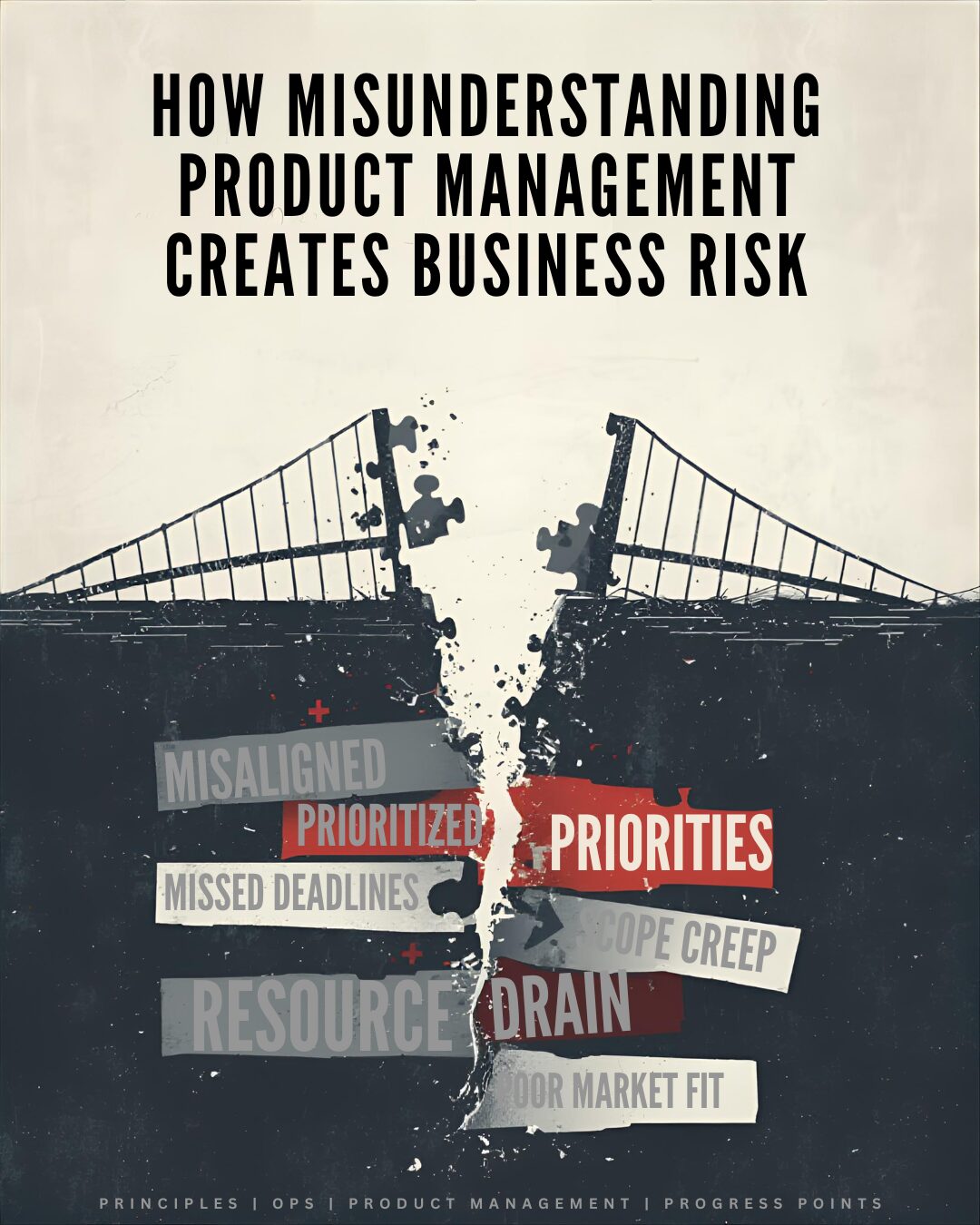
There’s a phrase I’ve heard more times than I can count over my career in product management:
“Let’s just have product handle it.”
It sounds harmless. Efficient, even. Like someone is trying to keep things moving.
But more often than not, that phrase is a signal—not of efficiency—but of risk.
And not just product risk.
Market risk.
Execution risk.
Founder risk.
Even cyber and compliance risk.
Most organizations don’t realize the damage until something breaks.
The Product Management Perception Problem
There’s a well-known meme that shows:
- What your parents think you do
- What your coworkers think you do
- What you actually do
For product managers, the gap between perception and reality is enormous.
Parents imagine you designing the future.
Coworkers sometimes assume you’re “not that busy.”
The reality? You’re running interference at every layer of the business.
When product management works well, nothing looks broken.
No fires. No chaos. No obvious heroics.
And ironically—that’s exactly why the role is misunderstood.
When “Just Have Product Handle It” Becomes Market Risk
Sales is often where this shows up first.
A deal is on the line. A customer asks a question. Someone says, “Let’s just loop in product.”
What’s actually happening in that moment?
Product becomes:
- A live demo engine
- A real-time feature translator
- Another point of contact in the sales process
The risk here isn’t speed—it’s misinformation.
When sales doesn’t fully understand the product:
- Customers fill in the gaps with assumptions
- Deals close on features that don’t exist
- Onboarding uncovers discrepancies
- Trust erodes—internally and externally
A knowledgeable sales team builds confidence.
A product team used as a crutch becomes a single point of failure.
That’s market risk hiding in plain sight.
Execution Risk: The Cost No One Sees
Now let’s talk about execution risk—the quiet kind.
Picture a product manager whose day looks like this:
- “Quick” meetings that aren’t quick
- Demos
- Strategy sessions
- Firefighting across teams
Deep work—the kind required for research, planning, roadmap design, and execution—doesn’t survive five-minute increments.
It gets pushed:
- Late into the evening
- Early into the morning
- Or sacrificed entirely
I’ve lived this.
During a critical product rollout, I spent entire days jumping between “just quick” conversations. By the end of the day, the actual work—workflow design, sprint planning—hadn’t happened.
So I did it after my kids went to bed.
And one night, I fell asleep sitting upright, laptop still open, because that was the only place left for focused work.
That wasn’t just personal burnout.
That was execution risk—delayed delivery, stressed teams, and degraded outcomes.
It doesn’t show up all at once.
It builds slowly. Like boiling a lobster without realizing the water is heating up.
Founder Risk Starts at the Top
Here’s the uncomfortable truth:
When product is constantly bypassed, it usually isn’t malicious.
It’s structural.
Founders and leaders often haven’t clearly defined:
- What product owns
- How escalation should work
- When involvement is necessary—and when it’s not
So teams escalate everything.
Or they try to triage issues themselves before product ever sees them.
The result?
- Confusion
- Rework
- Priority conflicts
- Burnout on both sides
Product managers aren’t junior note-takers or documentation machines.
Most PMs come into the role with deep experience—from engineering, QA, industry, business, or operations. They’re there to make business decisions, not slow them down.
Founders should ask themselves:
Am I unintentionally training my team to bypass product?
Because when that happens, founder overload increases—and alignment decreases.
Product Management Is an Early Warning System
This is where cyber, compliance, and operational risk enter the picture.
When teams say, “We’ll fix it later,” they almost never do.
Small risks compound:
- Market assumptions harden into contracts
- Execution shortcuts become technical debt
- Security gaps become breaches
Product managers are often the first to spot these patterns—not because they’re pessimistic, but because they’re trained to see systemic impact.
Ignoring risk doesn’t make it disappear.
It multiplies it.
Reframing the Role: Product as Risk Management
If product management is risk management, then a few things need to change.
Product managers:
- Stop apologizing for taking up space
- Protect your focus time
- Speak up early when you see risk forming
Founders and leaders:
- Clarify roles and escalation paths
- Don’t turn product into a catch-all
- Recognize PMs as strategic partners, not blockers
Product isn’t there to stop momentum.
Product is there to make sure momentum doesn’t drive the business off a cliff.
A Simple Framework to Take With You
- Identify risk early
Market, execution, founder, cyber—name it before it grows. - Clarify roles and paths
Eliminate single points of failure. - Communicate sooner than feels comfortable
Waiting is almost always more expensive. - Protect deep work
Execution depends on it.
Product management isn’t overhead.
It’s protection.
It’s foresight.
It’s how businesses scale safely, sustainably, and profitably.
And the next time someone says, “Let product handle it,”
the real question should be:
What risk are we actually creating right now?





Leave a Reply